My Beginnings in Morse Code and the Radios & Antennas Used
Manual Morse Intercept Operator

I learned Morse code while serving in the U.S. Marine Corps as an MOS 2621 – Manual Morse Intercept Operator. My training and experience involved intercepting and copying Morse code transmissions as part of Marine Corps signals intelligence operations. The MOS was later designated Communications Signal Collection/Manual Morse Code Operator/Analyst, but the fundamentals remained the same: listening carefully, copying accurately, and understanding Morse code at speed. That experience gave me a lifelong appreciation for CW and eventually brought me back to amateur radio and the art of making contacts with Morse code.
USAISD

After completing Marine Corps boot camp, I attended specialized training at Fort Devens, Massachusetts, which was home to the U.S. Army Intelligence School, Devens (USAISD). There, I received the technical training that prepared me for my duties as a Manual Morse Intercept Operator (MOS 2621). The training focused on learning Morse code, developing accurate copy skills, recognizing and intercepting coded radio transmissions, and understanding the fundamentals of communications intelligence. It required concentration, patience, discipline, and the ability to distinguish individual characters and groups of letters from continuous streams of Morse code. These skills were essential to identifying and recording intercepted communications that could later be analyzed for intelligence value.
The photograph above shows the training stations we used to learn Morse code. Although Morse code dates back to the earliest days of electrical communications, the equipment we trained on was computerized for its time, providing a structured way to practice receiving and recognizing transmissions. We spent hours listening to Morse code, building our copy speed, and learning to accurately record what we heard. This demanding training established the foundation for my work in signals intelligence and prepared me for the specialized responsibilities I would carry throughout my Marine Corps career.
Co. G Pyongtaek Korea

In the years between 1989-1991 I was stationed at Camp Humphreys in Pyongtaek, South Korea, and served as part of Company G, supporting Naval Security Group Activity (NSGA) Pyongtaek. Working alongside our U.S. Navy and Korean counterparts, we supported signals intelligence operations, including the collection, analysis, and processing of tactical communications intelligence. The mission also involved High-Frequency Direction Finding (HFDF), helping locate and monitor radio transmissions of intelligence interest, particularly those associated with that part of the world. This work contributed to U.S. intelligence gathering and situational awareness on the Korean Peninsula during a period of continued military tension. 1990 South Korea with North Korea in the Background.
1st Radio Battalion
.jpg/:/cr=t:0%25,l:0%25,w:100%25,h:100%25/rs=w:388,h:388,cg:true)
From 1991–1994, I was assigned to 1st Radio Battalion, U.S. Marine Corps, stationed at Marine Corps Base Hawaii in Kaneohe Bay, Hawaii. The battalion specialized in signals intelligence and tactical electronic warfare, intercepting and analyzing enemy communications to provide critical intelligence to Marine commanders. Along with our intelligence training, we also cross-trained as 2531 Field Radio Operators, learning the skills necessary to operate tactical radios, establish field communications, and maintain reliable communications in the field. This additional training gave us a broader understanding of Marine Corps communications and helped prepare us to support operational missions in different environments. Radio Battalion Marines relied on specialized equipment, technical expertise, adaptability, and teamwork to support operational planning and force protection. Although much of our work took place behind the scenes, it played an important role in helping Marines understand the communications environment and identify potential threats.
MEWSS

Besides my other duties and assignments while stationed at Kaneohe Bay, Hawaii, I was also part of the MEWSS (Mobile Electronic Warfare Support System) unit. MEWSS was a U.S. Marine Corps electronic warfare system designed to detect, intercept, and analyze radio communications and other electronic signals. Mounted on a modified Light Armored Vehicle (LAV), the system combined specialized antennas, receivers, and signal-processing equipment to help Marines collect signals intelligence and monitor activity within the electromagnetic environment.
Working with MEWSS provided valuable experience with the technical side of electronic warfare and the role communications intelligence played in Marine Corps operations. The vehicle's mobility allowed the unit to operate alongside Marine forces while carrying specialized equipment into the field. The system helped Marines identify and analyze radio transmissions of intelligence interest, providing information that could contribute to a clearer understanding of the operational environment. Operating this equipment required technical knowledge, attention to detail, teamwork, and the ability to adapt to changing field conditions. MEWSS provided mobile electronic warfare support to Marine units, helping commanders improve situational awareness and make informed operational decisions. Being part of the MEWSS unit was another important aspect of my service with 1st Radio Battalion, combining specialized intelligence work with the practical challenges of operating electronic warfare equipment in a tactical environment.
MEWSS in Somalia

The MEWSS contributed to operations in Somalia during Operation Restore Hope in 1992–1993 by providing electronic warfare and signals intelligence support to U.S. Marine Corps forces. Mounted on a mobile vehicle platform, the MEWSS was equipped to help Marines detect, intercept, monitor, and analyze radio communications and other electronic signals. Operating as mobile listening posts, MEWSS teams gathered information from radio transmissions and worked alongside other teams to use High-Frequency Direction Finding (HFDF) and triangulation techniques to help determine the location of signal sources. When required, the system could also provide radio-frequency jamming to disrupt selected communications. These capabilities supported situational awareness in a challenging operational environment, where understanding radio activity could help commanders assess potential threats, monitor communications, and coordinate Marine operations. The mobility of the MEWSS platform allowed Marines to reposition as operational requirements changed, bringing electronic warfare capabilities closer to the areas where they were needed. This work provided an important layer of electronic support to Marine forces operating in Somalia during a mission focused on establishing security and supporting humanitarian relief efforts.
Radios Used During My Tenure
AN/PRC 77 - "Prick 77"
AN/VRC-88, AN/VRC-89, and AN/VRC-90 SINCGARS Radios
AN/PRC 77 - "Prick 77"

the AN/PRC-77 was a familiar piece of communications equipment throughout the U.S. Marine Corps. This rugged, man-portable VHF-FM radio was used by Marines to maintain tactical voice communications between individuals, squads, and command elements in the field. Operating across the 30.00–75.95 MHz frequency range, the PRC-77 provided short-range communications and was compatible with the vehicle-mounted AN/VRC-12 family of radios. Its straightforward controls, durable construction, and portability made it well suited for field exercises and operational deployments. Although newer SINCGARS radios were beginning to replace older equipment during this period, the PRC-77 remained an important part of Marine Corps tactical communications. For field radio operators, it represented a dependable means of passing orders, coordinating movements, and maintaining contact when operating away from established communications facilities. As a note, the PRC-77 was primarily an analog voice radio, not a signals-intelligence collection system. Its ability to work with compatible tactical radios helped Marines maintain communications across different field and vehicle platforms.
AN/PRC 119
AN/VRC-88, AN/VRC-89, and AN/VRC-90 SINCGARS Radios
AN/PRC 77 - "Prick 77"

The AN/PRC-119 Single-Channel Ground and Airborne Radio System (SINCGARS) began entering Marine Corps service as a new generation of tactical communications equipment. Designed to replace older radios such as the AN/PRC-77, the PRC-119 provided Marines with a rugged, man-portable radio for maintaining voice communications in the field. The radio operated in the VHF-FM frequency range of 30.000 to 87.975 MHz, with 25 kHz channel spacing, providing 2,320 available frequencies. It supported both single-channel operation and frequency-hopping capability, which helped improve communications security and resistance to enemy jamming when properly configured. The radio could also transmit digital data, in addition to voice communications, and was designed to work with compatible SINCGARS radios across tactical command networks. Its manpack configuration allowed radio operators to carry the equipment during field exercises and operational deployments, maintaining communications between infantry units, command elements, and supporting forces. The AN/PRC-119 represented a significant advancement in tactical communications, helping establish the foundation for more secure and reliable radio networks used by the Marine Corps in later years.
AN/VRC-88, AN/VRC-89, and AN/VRC-90 SINCGARS Radios
AN/VRC-88, AN/VRC-89, and AN/VRC-90 SINCGARS Radios
The AN/VRC-88, AN/VRC-89, and AN/VRC-90 were vehicle-mounted configurations of the U.S. military’s Single-Channel Ground and Airborne Radio System (SINCGARS). These radios provided tactical VHF-FM communications between vehicles, field units, and command elements. Designed to replace older tactical radio systems, SINCGARS offered improved channel selection and the ability to operate in either single-channel or frequency-hopping mode when appropriately configured. All three radios operated in the 30.000–87.975 MHz VHF-FM band, with 25 kHz channel spacing, providing 2,320 selectable channels. They supported voice communications and, when configured appropriately, data transmission. Frequency hopping provided additional resistance to jamming and improved communications security when used with the required settings and equipment
AN/VRC-88: A short-range vehicle radio with additional equipment allowing it to be removed from the vehicle and configured for dismounted, manpack operation.
AN/VRC-89: A dual-radio configuration combining short- and long-range capabilities. Its two receiver-transmitters allowed operators to monitor one radio net while communicating on another.
AN/VRC-90: A long-range vehicle radio using a power amplifier to increase transmitting power and extend communications range.
AN/PRC-104 HF Manpack Radio
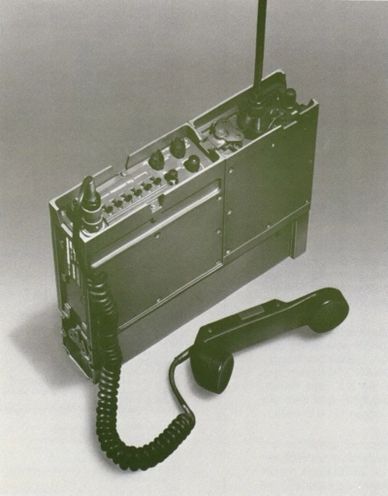
The AN/PRC-104 was an important man-portable high-frequency (HF) radio used the Marine Corps, for tactical long-range communications. Operating across 2.0000 to 29.9999 MHz, it could be tuned in 100 Hz increments, providing a wide range of frequencies for communications under varying field conditions. The radio supported single-sideband voice, continuous-wave (CW/Morse code), and data transmission. Its automatic antenna tuning and compact, rugged design made it suitable for field operations where reliable communications beyond the range of typical VHF radios were required. The AN/PRC-104 helped Marines maintain communications between field units and command elements over short and long distances, depending on propagation conditions, antenna setup, and terrain.
Other HF Radios
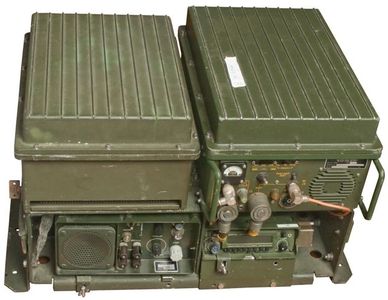
1. AN/PRC-105 a Manpack/ Portable HF radio related to the PRC-104, designed with a higher-power transmitter—commonly listed at approximately 100 watts. It supported long-range field communications using HF propagation. Frequency range: approximately 2–29.999 MHz.
2. AN/GRC-193 a Transportable or fixed higher-powered HF communications set used at command posts and other locations requiring longer-range communications. It could be installed in a shelter or vehicle configuration. Frequency range: approximately 2–29.999 MHz.
3. AN/MRC-138 a vehicle-mounted HF system based on the GRC-193 family, providing higher-power communications for mobile command elements and field units. Frequency range: approximately 2–29.999 MHz.
4. AN/TSC-120 a larger HF system used for longer-range communications at transportable or established communications sites. It supported communications beyond normal line-of-sight range. Frequency range: approximately 2–29.999 MHz.
Secure Communications Equipment
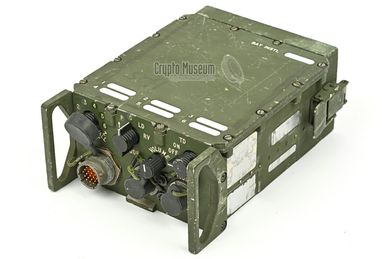
The Marine Corps used cryptographic equipment to protect tactical voice communications from unauthorized interception. These devices worked with compatible radios and communications systems to encrypt voice signals, allowing units to communicate securely when the equipment and networks were properly configured.
The TSEC/KY-57 VINSON was a tactical voice encryption device widely used by the Marines and it could be connected to compatible radios, including the AN/PRC-77, to provide secure voice communications over tactical VHF-FM radio nets. The KY-57 used digital encryption to protect voice traffic, with authorized users requiring compatible equipment and the appropriate cryptographic keying material. It was an important part of tactical communications security, helping protect operational conversations from being understood by anyone monitoring the radio frequency.
The TSEC/KY-65 PARKHILL was a narrowband secure voice device designed primarily for HF radio communications. Unlike the KY-57, which used digital voice encryption, the KY-65 used an analog voice-scrambling method. It was intended to provide secure voice communications over HF circuits, including compatible HF radios such as the AN/PRC-104. This made it relevant for long-distance tactical communications where HF propagation was needed.
Antennas
VHF Antennas
1. AS-3683 — Short tape antenna - A compact, flexible antenna used with SINCGARS manpack radios. It was convenient when moving through brush, working in confined spaces, or carrying the radio while maneuvering.
2. AT-271A/PRC — Long whip antenna - A long, flexible whip used with manpack radios such as the AN/PRC-77 and other compatible VHF tactical radios. Its length helped provide better communications performance than a short antenna in many field conditions.
3. OE-254/GRC — Ground-mounted antenna Field communications sites - A portable, broadband antenna mounted on a sectional mast. It operated across approximately 30–88 MHz and could improve SINCGARS and compatible VHF radio coverage at command posts and field positions.
4. AS-3900/VRC — Vehicle-mounted antenna - A tall vehicle antenna used with SINCGARS installations, including the AN/VRC-88, VRC-89, and VRC-90 configurations. It provided VHF-FM communications from tactical vehicles.
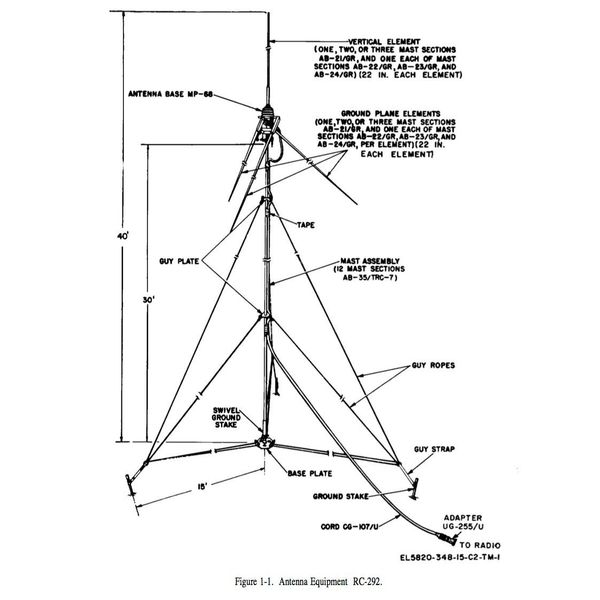
5. RC-292 (pictured above) — Directional/ground-plane-style mast antenna system. An older field antenna system used with compatible VHF tactical radios, including radios in the PRC-77 era. Its elevated antenna arrangement could extend communications compared with a low-mounted whip.
HF Antennas
One of the most common antennas used with the AN/PRC-104 HF manpack radio was the standard whip antenna, which allowed Marines to operate while moving or when there was insufficient time to establish a larger antenna. Although portable and quick to deploy, the whip generally provided more limited range than a properly erected wire antenna.
For longer-range communications, Marines could deploy wire antennas, including the AT-984 “Fishreel” sloping-wire antenna and dipole antennas from the AN/GRA-50 antenna group. The Fishreel used a length of wire that could be adjusted for different operating frequencies. Dipoles could be erected between trees, poles, or other supports, while inverted-V configurations offered a practical option when suitable supports were available. These wire antennas generally provided better performance than the whip for many long-distance HF communications tasks.
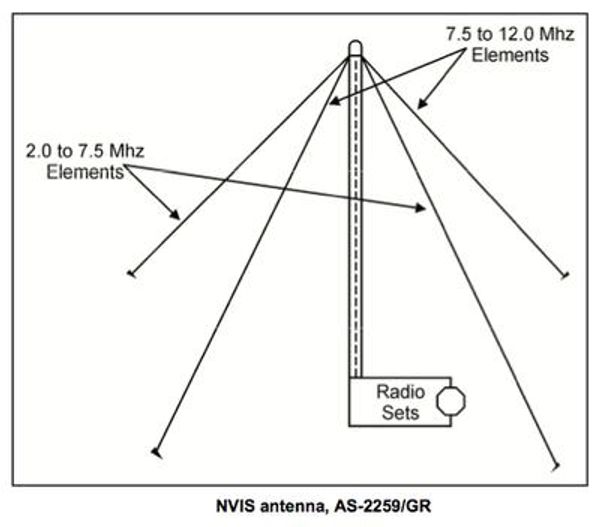
Another important configuration was the Near Vertical Incidence Skywave (NVIS) antenna AS-2259 (pictured above). NVIS sends HF signals upward toward the ionosphere, allowing them to return to Earth over relatively short and intermediate distances. This was particularly useful when communicating with other tactical units beyond normal line of sight, especially in areas where hills, vegetation, or terrain made direct radio paths difficult.
The antenna choice depended on the mission, terrain, frequency, time of day, and required communications distance. In a mobile or rapidly changing tactical situation, the whip offered convenience; at a fixed field position, a sloping wire, dipole, or NVIS antenna could provide more reliable communications. For Marines working in radio battalions and other communications units, understanding antenna setup and HF propagation was an important part of establishing and maintaining tactical communications.
Frequency Jamming Equipment

During my era the U.S. Marine Corps used electronic warfare capabilities to support battlefield intelligence and tactical operations. Within Marine Corps Radio Battalions, these missions included detecting, analyzing, and locating enemy radio communications, as well as supporting efforts to disrupt opposing forces' communications.
The AN/ULQ-19(V) Responsive Automatic Control Jammer (RACJAM) represented a different side of military radio operations. Rather than simply transmitting or intercepting communications, electronic warfare equipment was designed to interfere with an adversary's ability to communicate effectively. By targeting designated radio frequencies, jamming could disrupt voice transmissions and make tactical radio nets difficult to use. These capabilities complemented the broader Marine Corps electronic warfare mission, helping commanders understand and counter enemy communications while supporting operations in the field.
Radio frequency (RF) jamming works by transmitting radio energy that interferes with an intended signal, making voice communications difficult or impossible to understand. The AN/ULQ-19(V) RACJAM represented this electronic warfare capability, supporting efforts to disrupt enemy tactical VHF radio communications. By targeting designated frequencies, jamming could mask speech, introduce interference, or make tactical radio nets unreliable.
For the U.S. Marine Corps, this capability complemented the broader electronic warfare mission of detecting, analyzing, and locating enemy communications while disrupting their ability to coordinate operations. The important distinction is that jamming attacks the communication link, not the radio itself; it does not necessarily damage equipment, but instead prevents the intended signal from being received clearly. Its effectiveness depends on signal strength, distance, terrain, frequency, and the receiving radio's ability to reject interference.