KEYS & Components
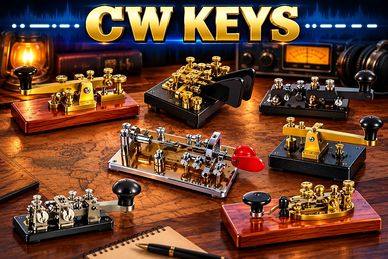
Keys are used by amateur radio operators to send dits and dahs over the air using Continuous Wave (CW) transmissions. Several types of keys are available, each offering a different sending experience:
Whether operating QRP in the field, enjoying casual QSOs, or making long-distance HF contacts, the best CW key depends on personal preference, comfort, and sending style. Each type offers its own feel and challenges, making Morse code operating a rewarding skill to explore. 73!
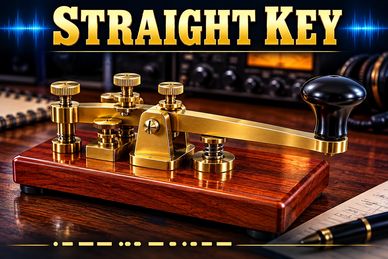
The Straight Key is the traditional Morse code key used by amateur radio operators for generations. Operated by pressing a lever up and down, the operator manually creates every dot and dash. Simple, reliable, and satisfying to use, the straight key is an excellent choice for beginners learning CW and experienced operators who enjoy the classic art of Morse code.
.png/:/rs=w:388,cg:true,m)
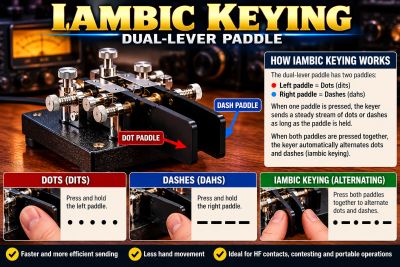
The Dual-Lever Paddle, also known as an Iambic Key, is a popular choice among amateur radio operators for sending Morse code (CW) efficiently and comfortably. It features two paddles: one for dots (dits) and one for dashes (dahs). When connected to an electronic keyer, squeezing both paddles together activates iambic operation, allowing the keyer to alternate between dots and dashes automatically. This reduces hand movement, promotes consistent timing, and can increase sending speed. Dual-lever paddles are widely used for everyday HF contacts, contesting, and portable QRP operations.
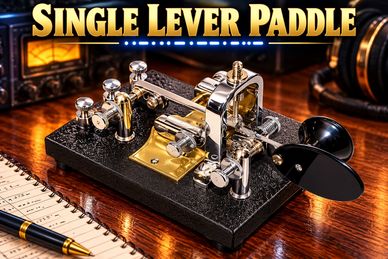
The Single-Lever Paddle is a popular Morse code key used by amateur radio operators for sending CW (Continuous Wave). Unlike a dual-lever iambic paddle, it uses a single lever to generate both dots (dits) and dashes (dahs), with the operator moving the paddle in opposite directions for each.
Single-lever paddles offer precise control over Morse code timing and rhythm, making them an excellent choice for both beginners and experienced CW operators. They work with an electronic keyer, which automatically controls the duration and spacing of dots and dashes, allowing for smoother sending and reduced hand fatigue.
Many operators appreciate the single-lever paddle for its simplicity, accuracy, and traditional feel. Whether operating from a home station or enjoying portable activities like Parks on the Air (POTA), it is a reliable tool for anyone who enjoys the art of Morse code.
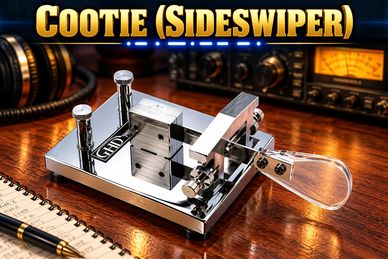
The Cootie Key, also known as a Sideswiper, is one of the earliest forms of semi-automatic Morse code keys used by telegraphers and amateur radio operators. Unlike a straight key, which moves up and down, the Cootie uses a horizontal lever that moves from side to side. The operator manually creates both dots and dashes by alternating the lever in opposite directions, while developing their own rhythm and timing.
The Sideswiper was popular before the widespread use of mechanical bugs and electronic keyers. Today, it remains a favorite among CW enthusiasts who appreciate its simplicity, vintage character, and unique operating style. Using a Cootie Key requires practice and coordination, but for many operators, that hands-on experience is part of the fun of sending Morse code.
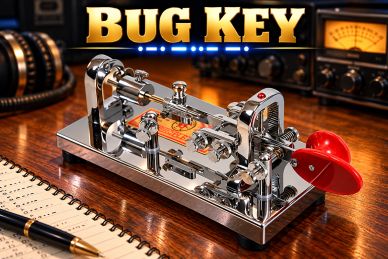
The Bug Key, also known as a semi-automatic Morse code key, is a classic telegraph key that allows amateur radio operators to send Morse code faster and with less hand movement than a traditional straight key. When the operator moves the paddle to one side, the key automatically generates a series of dits (dots), while dahs (dashes) are made manually by holding the paddle in the opposite direction. Invented by Horace G. Martin and introduced by the Vibroplex Company in 1905, the Bug Key became popular with professional telegraphers and is still enjoyed by amateur radio operators today. It combines mechanical precision, operating skill, and a touch of radio history, making it a favorite among CW enthusiasts who appreciate the art of sending Morse code.
Components
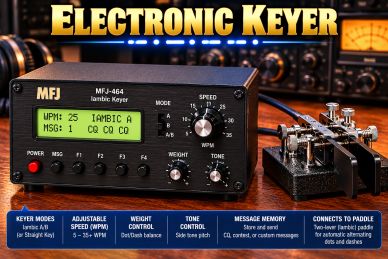
An Electronic Keyer is a device used in amateur radio to make sending Morse code faster, smoother, and more consistent. When connected to a dual-lever or single-lever paddle, the keyer automatically generates properly timed dots (dits) and dashes (dahs), allowing the operator to concentrate on rhythm and accuracy rather than manually controlling each element.
Most modern electronic keyers offer adjustable sending speeds, precise timing, and features such as iambic keying, which allows dots and dashes to be combined by squeezing both paddles together. Many HF transceivers have a built-in electronic keyer, while standalone keyers can be used with radios that lack this feature.
Electronic keyers are popular with CW operators because they reduce repetitive hand movements, improve consistency, and make higher-speed Morse code more comfortable to send. Whether you're operating from a home station, participating in a contest, or enjoying Parks on the Air (POTA), an electronic keyer is an excellent tool for improving your CW operating experience.
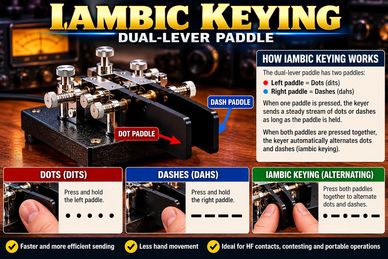
Iambic keying is a method of sending Morse code (CW) in amateur radio using a dual-lever paddle connected to an electronic keyer. It allows an operator to send dots (dits) and dashes (dahs) with fewer individual finger movements, making CW operation more efficient, consistent, and comfortable, particularly at higher sending speeds.
Unlike a traditional straight key, where the operator manually controls the duration of every transmitted element, an electronic keyer automatically generates correctly timed dots and dashes. The operator simply controls the paddle movements, while the keyer handles the timing, spacing, and sequence of the Morse elements.
(See Below for More Info),
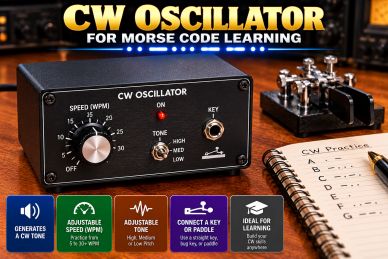
A CW Oscillator, commonly known as a Code Practice Oscillator (CPO), is an electronic device that produces an audible tone when a Morse code key is pressed. It allows operators to practice sending Morse code without needing a radio transmitter or an antenna.
When connected to a straight key, bug, or paddle with an electronic keyer, the oscillator generates a tone that lets the operator hear the dots and dashes as they are sent. Many models include adjustable volume and tone controls, while some incorporate an electronic keyer for practicing with paddles.
Code practice oscillators are excellent tools for beginners learning Morse code and experienced amateur radio operators refining their sending technique. They are also useful for testing keys, adjusting paddle contacts, and practicing CW anywhere without transmitting over the air.
Whether you're learning your first Morse code characters or keeping your CW skills sharp, a code practice oscillator is a simple, affordable, and valuable addition to any amateur radio workbench.
Iambic Keying
How Iambic Keying Works
A typical iambic keying system consists of a dual-lever paddle, an electronic keyer, and a radio transmitter. The paddle has two independent levers: one for dots and the other for dashes. Pressing the dot lever requests a short Morse element, while pressing the dash lever requests a longer element, normally three times the duration of a dot.
The electronic keyer interprets the paddle inputs and produces the appropriate sequence of Morse elements. It also controls the timing between elements, helping to maintain consistent code spacing and rhythm. The resulting keying signal is sent to the transmitter, which switches the radio-frequency carrier on and off to produce the Morse code transmission.
The defining feature of iambic keying is the ability to activate both paddles simultaneously. When both dot and dash levers are pressed together, the keyer alternates between dots and dashes for as long as the squeeze is maintained, subject to its timing and memory logic. Depending on which paddle is activated first, the sequence may begin with either a dot or a dash.
For example, the letter R consists of dot-dash-dot, while the letter K consists of dash-dot-dash. By using coordinated paddle movements and squeeze techniques, an operator can generate these alternating sequences with fewer separate finger movements than would normally be required when operating each lever independently.
However, not every character can be sent with a single squeeze. The number of movements saved depends on the character, the operator's technique, and the electronic keyer's operating mode.
Iambic Mode A and Mode B
Most electronic keyers that support iambic operation offer two common modes: Mode A and Mode B. The primary difference is how the keyer responds when both paddles are released during an element generated by a squeeze.
In Mode A, the keyer completes the element already in progress but does not generate an additional opposite element solely because the squeeze has been released. This behavior can be predictable once the operator becomes familiar with the timing.
In Mode B, releasing both paddles during an element generated by a squeeze can cause the keyer to send one additional element of the opposite type. For example, releasing during a dash may result in an additional dot, while releasing during a dot may result in an additional dash. This behavior can make certain characters easier to send with a single squeeze-and-release action.
The exact response can vary with the keyer's design and firmware, so operators should consult the manufacturer's documentation for their particular equipment. Neither mode is universally superior; the preferred choice depends on the operator's technique and personal preference.
Dual-Lever Iambic Paddles Compared with Single-Lever Paddles
Although both dual-lever and single-lever paddles can be used with electronic keyers, they differ mechanically and in how the operator generates Morse code.
A dual-lever iambic paddle has two separate moving levers, allowing the operator to activate the dot and dash contacts simultaneously. This permits squeeze keying, which can reduce the number of individual movements required for alternating dot-dash sequences.
A single-lever paddle has one moving lever that operates the dot and dash contacts in opposite directions. The electronic keyer still generates correctly timed elements, but the operator must alternate the lever movements rather than squeeze both contacts simultaneously.
Single-lever paddles are often mechanically simpler and may feel more intuitive to operators who prefer distinct, deliberate movements. Dual-lever paddles provide additional flexibility and can improve sending efficiency when squeeze techniques are mastered.
Both types are capable of producing excellent CW. The main advantage of a dual-lever iambic paddle is the potential reduction in repetitive finger movements, rather than an inherent improvement in Morse code timing or signal quality.
Benefits of Iambic Keying
One of the principal benefits of iambic keying is reduced finger movement. By squeezing both paddles, operators can generate alternating dots and dashes without having to move each lever separately for every element. This can be particularly useful for characters such as A, N, R, K, and C, which contain alternating dots and dashes.
Another important benefit is consistent timing. The electronic keyer determines the duration of dots and dashes and maintains the correct spacing between elements. This reduces timing variations that might otherwise result from manually controlling each transmitted element.
Iambic keying may also reduce repetitive hand movement and fatigue during extended operating sessions. When combined with a relaxed grip, properly adjusted paddle tension, and suitable spacing, it can make longer CW sessions more comfortable.
At higher sending speeds, the combination of automatic timing and efficient paddle movements can help operators maintain a smooth, consistent rhythm. Nevertheless, the benefits depend on practice, technique, and individual comfort. Iambic keying does not automatically make an operator faster or more accurate; these improvements develop through experience.
Learning to Use Iambic Keying
Operators learning iambic keying should begin at a comfortable sending speed and concentrate on producing clean, correctly spaced elements. A starting speed of approximately 12–15 words per minute (WPM), or slower if necessary, can be suitable for initial practice.
The first step is to become familiar with the individual dot and dash paddles. Once each lever produces the expected element, the operator can begin squeezing both paddles and listening to the alternating sequence generated by the keyer.
Practising common alternating-element characters, such as A, N, R, K, and C, helps develop coordination and familiarity with squeeze timing. Operators can then experiment with Mode A and Mode B to determine which behavior feels more natural.
Speed should be increased gradually, with priority given to accuracy, consistent spacing, and relaxed hand movements. As technique improves, iambic keying can become a natural and efficient method of sending Morse code.
Conclusion
Iambic keying is an effective technique for amateur radio CW operation that combines a dual-lever paddle with an electronic keyer to simplify the generation of Morse code. Its ability to interpret simultaneous dot and dash inputs allows operators to send alternating-element sequences with fewer deliberate finger movements.
The electronic keyer provides consistent timing and spacing, while the choice between Mode A and Mode B allows operators to select the squeeze-release behavior that best suits their technique. Compared with a single-lever paddle, a dual-lever iambic paddle offers additional flexibility and the potential for greater sending efficiency, although it requires practice to use effectively.
Ultimately, both single-lever and dual-lever paddles are valuable tools for CW operators. The best choice depends on personal preference, comfort, and operating style. With proper technique and practice, iambic keying can contribute to smoother, more consistent, and more comfortable Morse code operation.